







Japan has greatly advanced the field of interdimensional travel. Even more impressively, they’ve done so using that most mundane of transportation technologies, the truck. If anime, manga, and light novels are to be believed, one can hardly step blindly into traffic without being immediately transported to some other world…
Alas, in the West, the only places to which truck-kun will deliver you is the emergency department or the graveyard. Therefore, Western SF authors have turned to a wide variety of means by which one can step from this boring, mundane world into exciting realms of adventure (and maybe death).
Consider these venerable examples.
Retrograde Reincarnation — “Time and Time Again” by H. Beam Piper (1947)
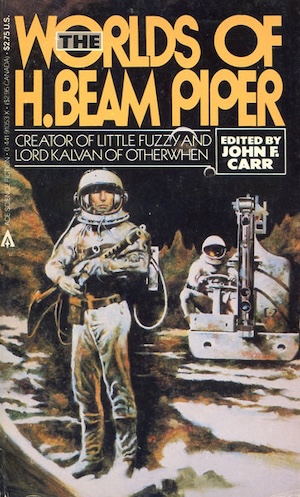
Allan Harley is mortally wounded during the 1975 siege of Buffalo, one of many victims of an enemy atomic bomb. Medics cannot save him, only administer enough drugs to spare Allan unnecessary pain. There is no future for Allan.
There is, however, a past.
Allan wakes in 1945, with all the memories of his older self. He wastes no time testing to see if his knowledge of what is to come is correct, rather than a convincing delusion. The experiment is a monumental success: not only does Allan know 1945’s future, he can—with a little help from his father—change it. Perhaps Buffalo will be spared that atomic bomb.
This was Piper’s first published story. There aren’t a lot of science fiction stories that explicitly reference J.W. Dunne’s An Experiment with Time1, but this is definitely one of them.
Applied Logic — The Compleat Enchanter by L. Sprague de Camp and Fletcher Pratt (19752)
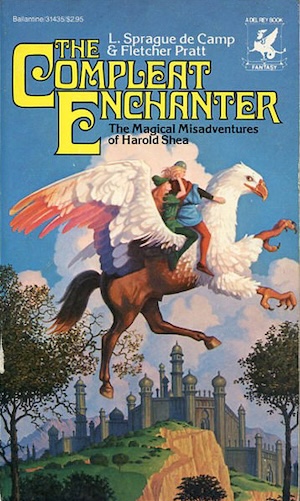
What is for psychologist Reed Chalmers a promising therapeutic breakthrough is for Chalmers’ colleague Harold Shea something far more valuable: escape from mundane life into worlds of adventure. Simply by arranging one’s thoughts correctly, one can be transported to any world one can imagine.
The—well, a—catch with this so-called “syllogismobile” is that the method is imprecise. One may set out for the world of Irish myth, only to find oneself in Norse myth, immediately before Ragnarök. In fact, Shea does set out for the world of Irish myth, only to find himself in Norse myth, immediately before Ragnarök. What hope has a simple academic of surviving the end of the—well, a—world in this, the first of Shea’s many adventures?
Shea isn’t just running towards adventure. He’s fleeing from his intimidating (and better paid) soon-to-be-former girlfriend, Gertrude. Don’t worry about Gertrude: she can do better than Shea and almost immediately does3.
Summoning Spells — The Doomfarers of Coramonde by Brian Daley (1977)
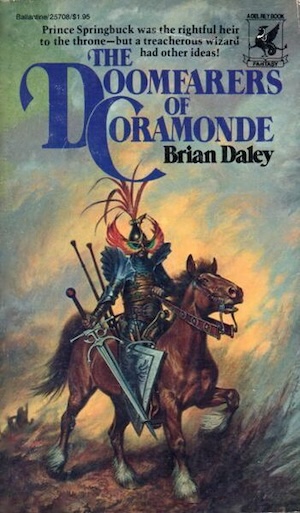
Springbuck is the rightful heir to the throne of Coramonde. However, sorcerer Yardiff Bey has qualifications Springbuck lacks, such as ruthlessness, cunning, magic, and pretty much every non-doomed member of the court as allies. Springbuck does manage to escape, but the village he chooses as his refuge is targeted for destruction. Springbuck is only safe for as long as it will take Bey’s dragon to find and incinerate Springbuck and the village in which he is sheltering.
However, that village is home to teacher Van Duyn and his sorcerous pals Andre and Gabrielle deCourtney. They have the means to summon an ally across space and time—one equal to a dragon—before the dragon arrives. Cue the sudden arrival of American soldier Gil MacDonald and the rest of the crew of the armoured personnel carrier Lobo, straight from the battlefields of Vietnam.
They don’t make suits of armour like the one pictured on the original mass market paperback anymore.
Generally speaking, when one impresses soldiers into a conflict involving arcane forces with which those soldiers are unfamiliar, courtesy dictates one at least feigns enthusiasm about the draftees. Instead, Van Duyn just grumbles that he was hoping for a tank, or maybe mobile artillery.
Portal (artificial) — Shadow of Earth by Phyllis Eisenstein (1979)
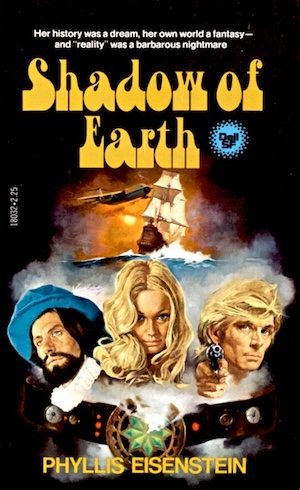
Parsimonious grad student Larry Meyers hired twenty-year-old Celia Ward to tutor him in Spanish. Then Larry seduced Celia, which was a huge money-saver for Larry. The romance proceeded happily until Celia discovered her older boyfriend’s alarmingly large hidden stash of firearms.
There is a perfectly innocent explanation. Having discovered the means to travel between parallel worlds, Larry is running guns to that other, far less developed world. To prove he is not lying, Larry transports Celia there… where he promptly abandons her. She is soon captured and sold to the Marquis de los Rubios. Not as a slave or concubine, as a wife. But still…
Larry is not going to save Celia, so she will just have to save herself.
No matter how low your opinion of Larry is (based on the above), I assure you it is not low enough.
Table-top Roleplaying Game Accessories — Quag Keep by Andre Norton (1978)
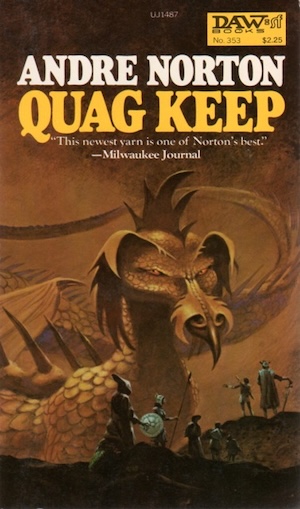
Dungeon Master Eckstern gleefully displays his brand-new, expensive miniatures. Player Martin Jefferson is compelled to grasp one figure in particular. Having done so, he and his companions are instantly transported to TSR’s World of Greyhawktm and brainwashed into thinking they are and always have been natives of that realm.
This being Greyhawktm, there is a quest. Norton being determined to expeditiously push the characters in the right direction, there is also a geas compelling Martin and company to slide along the greased rails of the plot. The fate of the world may or may not depend on the outcome. Martin’s fate definitely will.
To be frank, this is a terrible, terrible book. However, it does provide an explanation for something I overlooked when I was in the TTRPG industry (because the information was not easily available): sales fell off a cliff in the early 1980s4. If customers were being transported via miniatures to other dimensions and forced to partake in stock plots, that would explain why sales declined. If I’d known, I definitely would have put a small warning label on the back of the packages.
These are but a few of the truck-kun alternatives for interdimensional travel. I didn’t even touch on the utility of tornadoes or rabbit holes in this matter. If I have overlooked your favourite travel methods, please extol their virtues in comments below. Be sure to let us know which method actually worked for you.
- I can only think of one other: James Blish’s Jack of Eagles. ↩︎
- 1975 is the date of the collection, but the stories themselves are from an earlier era, which I mention to provide context for the next footnote. ↩︎
- The gender dynamics in the Shea stories are fascinating. Shea, and to a lesser extent his pals, dream of being he-man manly men, and are rather snarky about Gertrude… provided she is out of earshot. However, none of the men seem to be bold enough to say no to her and she treats Shea’s social circle as her personal serial reverse harem. ↩︎
- If I can find my long-forgotten source for this assertion, I will add a link or at least a pointer. ↩︎

I assume wardrobes, rabbit holes, and an errant tornado were covered by another column? ;-)
Rabbit holes, yes, but you neglected to mention mirrors.
Take a closer look at the closing paragraph of the article.
Still leaves Wardrobes :)
Odd coincidence: this went live the same day as my review of The Sleeping Dragon (also a transported to D&D novel).
Quag Keep would seem to be somewhat opposite to the fears of certain parents (the ones that make Karens appear completely sane and reasonable) that great evil would be brought into the world by TTRPG.
Doomfarers counts as Portal (artificial) as well. Van Duyn arrived through a self-built one.
For a case of Portal (natural), see the Touchstone trilogy by Andrea K. Höst.
Well Thomas Covenant made his first journey end seventies if not by truck but at least by an old-fashioned car. Now the question to answer: Were there already isekais and should he have known that he had to take a truck?
There were two isekai anime: Urashima Taro (who rode a magic turtle) and Paul’s Miraculous Adventures (generic magic portal) before 1977. While there are earlier similar vechicular incidents (going all the way back to Astro Boy), truck-triggered isekai didn’t really start until Jobless Reincarnation in 2012.
Urashima Tarou is a classic Japanese fairy tale, far older than anime. The Dragon Palace isn’t an isekai, but a magical/divine undersea kingdom where the protagonist is entertained for several days, only to return home and find that a century has passed. The Japanese term for relativistic time dilation is “the Urashima effect.”
True. But it was animated in 1917, and hence, it counts for this discussion. :)
Hmm, I was going to argue that it wouldn’t count as isekai because it’s a fantasy realm on Earth rather than a parallel world, but Wikipedia says that Urashima Tarou is the forerunner of the isekai genre, along with the Oz books, so I guess it can include locations on Earth that are “otherworldly” in one way or another. Or at least, parallel-world portal fantasies are a subset of the broader genre of stories about travel to otherworldly realms, whether on or off Earth.
Sure. I mean, the various Fae realms probably count as well. You could even make cases for time travel stories, since the distance is temporal, not geographical. Indeed, Inuyasha has all the hallmarks of an isekai despite ostensibly taking place on Earth.
If you do want to stick with the traditional Anime method and take a much more active role in the procedure, check out the upcoming game Truck-kun is Supporting Me from Another World?! on Steam. It has a demo available if you want to try out the
vehicular manslaughterfun driving ascension experience for yourself.Two stories I encountered in grade school made use of magical incantations to excellent effect, to the extent that I can still remember the incantations decades later despite having long since mislaid the source works.
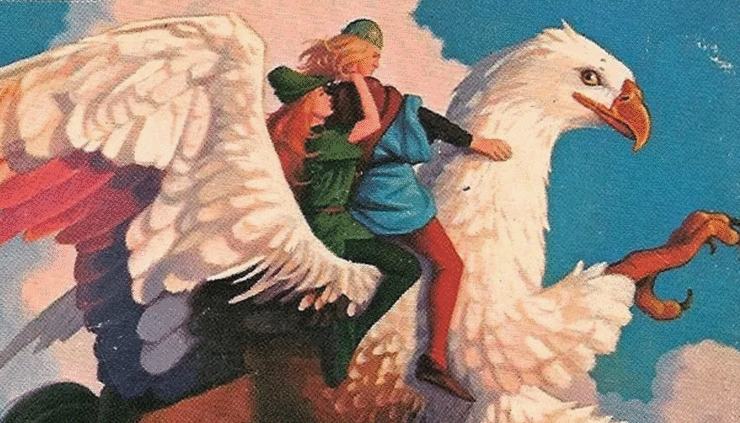
The better known of the two (though nowadays decidedly obscure) was from Dan Wickenden’s The Amazing Vacation. (I was confused about the authorship of that one for a really long time because I had acquired it used and jacketless, and someone had pasted in the jacket copy from a completely different book about real-world travel to Mexico inside the front cover. And the book itself vanished two moves ago, and is scarce enough that I haven’t had the opportunity to replace it. The setup involves a pair of youngsters on summer vacation at a relative’s house who discover that one of the windows in said house can open to Elsewhere:
Entry kentry cutry corn, apple seed and apple thorn;
Wire, briar, limber lock, a witch and griffins in a flock.
We fly o’er hill and o’er plain; we fly through sun and wind and rain.
We even fly when it’s sleeting or snowing,
So Open Sesame, let’s get going!
(The verse evolves as the book progresses, additional companions are added, and the kids’ mission changes somewhat.)
////
The second incantation(s) actually (probably) date somewhat earlier, and the source work’s title and author are now long lost to me – that one came from a short play from a magazine called PLAYS which was produced specifically for grade school libraries. In this instance, the gimmick was not unlike that of the far more famous “Magic School Bus” franchise (which I’m sure it predated) – but the play’s vehicle was a bookmobile – and as it happens, I have the distinct memory of having checked out that particular issue of that particular magazine from the county library system bookmobile that visited my grade school once a week.
Things are never what they seem
Walls and floor may be a dream
A wink of eye may change this scene
From bookmobile to time machine!
There were several intervening transports in that one – riffing, not surprisingly, on various memorable historical or fantastical settings, each triggered by a brief verse – until the final voyage back to the present:
Things are never what they seem,
Walls and floor may be a dream,
A wink of eye may make things real –
From time machine to bookmobile!
James Blish warned me of the dangers of falling into a radio telescope: Midsummer Century
Another Summoning Spell very similar to Doomfarers is the novella Sword Brother, by David Weber.
Well, since the Wardrobe has already been mentioned, let us consider the other methods used to reach Narnia: A summoning spell (Prince Caspian), an unexplained magic picture (The Voyage of the “Dawn Treader”), a petition to Aslan to be permitted to enter Narnia (The Silver Chair), nothing at all because the characters were already there (The Horse and His Boy), magic rings that take you through the Wood Between the Worlds (The Magician’s Nephew) and train-kun, which might also have involved those same rings, and certainly deaded the characters on Earth (The Last Battle). Say what you like about Lewis, he certainly didn’t repeat himself.
Keith Laumer used something similar to de Camp and Pratt’s method in his Lafayette O’Leary series. In the first novel, Lafe uses autohypnosis to change worlds. True, he was originally from the fantasy world he winds up in, but he’s even able to use his technique as a sort of summoning magic for useful items. Subsequent stories tend to use artificial portals or other significantly advanced technology.
There’s also the possibility that an amphibious sorcerer singing a somewhat imprecise spell could accidentally summon you.
J. B. Priestley used Dunne’s idea for several things, including the novel The Thirty-First of June. And Rumer Godden’s absolutely gorgeous novel A Fugue in Time also is influenced by Dunne. I can’t remember offhand (will check when I get home) whether those books explicitly cite An Experiment in Time, however.
The Godden novel is marginally science fiction (it is set in 1840, 1880, and 1940, and then a bit in roughly 1960. (The novel was published just post-War. The Priestley novel is light fantasy.
Personally, I love the transportation to another world method in Catherynne Valente’s The Girl Who Circumnavigated Fairyland in a Ship of Her Own Making: The Leopard of Little Breezes.